


CLUNKER CLASS RULES
Brought to you by Finish Line Productions
Mark "Doc" Davis
And
James "Bud" Smith
Drivers! Click here to print the registration form!
All participants are responsible for reading and understanding these rules. If ANY area is unclear, it's the participants' responsibility to contact race officials for clarification.
- Click below to print rules.

Body
- 1. Any car that is 2dr, 4dr, or SW allowed.
- 2. Must have all body panels intact. All body panels must be securely fastened to vehicle.
- 3. No reinforcing of body allowed.
- 4. Front doors must be able to open and close in stock manor.
- 5. All headlights, tail lights, mirrors and misc. plastic parts must be removed.
- 6. Drivers compartment must be properly sealed from outside conditions.
- Example: No open gaps between bottom of door to the rocker panel. No large holes or gaps in floor boards.
- 7. Must have tow hooks or tow chains. Hooks and chains must be mounted securely to vehicle's frame. Hooks and chains must be visible and easy to access.
- 8. All cars must have numbers on both doors and roof. Door numbers must be a minimum of 22" tall and 3" wide. Roof numbers must be a minimum of 24" tall and 3" wide. Bottom of roof number must point towards passenger side.
- 9. Numbers must be a contrasting color from car. No reflective material can be used for car numbers.
- 10. No vulgar language or images will be allowed on vehicle.
- 11. All glass must be removed from vehicle. Windshields may be left in place as long as they are in good shape and not considered a safety hazard.
Interior
- 1. All carpet, door panels, extra seats, headliners, insulation and glass must be removed from vehicle. Front windshields may be left in place as long as they are in good shape and not considered a safety hazard.
- 2. Stock dash must remain in place.
- 3. Ok to remove heater controls, stereos, and instrument cluster.
- 4. All airbags must be removed.
- 5. 1 seat only. Must be in stock driver's location for make of vehicle.
- 6. Seat must be a stock style seat. No race seats allowed.
- 7. No loose objects.
- 8. All parts of the vehicle's fuel system (pump, tank and lines) must be located outside of the driver compartment.
Frame/Suspension/Steering/Brakes/Weighting
- 1. All frames (uni body), suspension, steering, and brake components must be stock or an OEM replacement for make, model and year of vehicle.
- 2. No weighting allowed.
- 3. No reinforcing of suspension components or of chassis.
Roll Cage
- 1. No roll cage necessary if vehicle cab is in good shape.
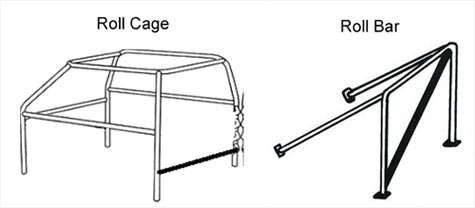
- 2. If vehicle has been rolled, a minimum of a standard 4 point cage must be installed.
- (see illustration below) HIGHLY RECOMMEDED FOR ALL VEHICLES.
- 3. Roll bars and hoops must be built from a minimum of a 1 ½ round type tubing and .095 thickness.
- 4. Each corner of cage at frame or floor contact point must have a floor plate 4x4x1/8" and have at least 2, 2"x2"x1/8 gusset. HIGHLY RECOMMEND having same style gussets at all tubing junctions.
- 5. Floor plate must be bolted to floor board, or directly welded to frame.
- 6. No roll bar or cage may enter engine compartment.
- 7. All tubing must be bent when changing angle. No cutting and notching to make a curve.
- 8. All roll bars and cages will be inspected.
Bumpers
- 1. All vehicles must have a front bumper and rear bumper.
- 2. Bumpers must be stock for make, model and year of vehicle.
- 3. May remove bumper cover skin. OEM bumper reinforcement must be left on vehicle.
- 4. May attach tow hooks or tow chains to bumpers. All tow hooks and tow chains will be inspected.
- 5. Bumpers may be welded or bolted to frame. All bumper mounting will be inspected.
Engine/Transmission
- 1. Engine must be stock for make, model, and year of vehicle.
- 2. No aftermarket heads, intakes, or blocks.
- 3. May be carbureted or fuel injected.
- 4. Transmissions must be stock for make, model and year of vehicle.
- 5. Transmission may be a manual or automatic type.
- 6. All transmissions must have minimum of 1 forward gear, reverse gear, and neutral.
Induction & Fuel Systems
- 1. May run aftermarket air intake systems.
- 2. K&N type filters OK.
- 3. No NOS allowed.
- 4. No super charges allowed.
- 5. Turbo allowed only if it came originally equipped on your vehicle.
- 6. Must run stock EFI system.
- 7. If carbureted, may run aftermarket carb, but no larger then 650 CFM.
- 8. Pump gas only. No aviation fuel. No fuel additives.
- 9. Must run OEM intake for make, model and year.
- 10. Must run OEM fuel tank for make, model and year.
- 11. Fuel tank must mount in stock location under vehicle. Exception: Fuel tanks that originally were mounted in cab must be moved. All relocated fuel tanks will be inspected.
Exhaust
- 1. No headers allowed unless stock for make, model and year of vehicle.
- 2. Exhaust must exit under vehicle and behind driver.
- 3. OK to remove catalytic converters.
- 4. Exhaust must be mounted securely.
Wheels & Tires
- 1. Maximum tire size of 235/75/15. Measurement will be based on manufacturer's imprint on side of tire.
- 2. Tire must be DOT approved MT or AT tire. No studded tires will be allowed.
- 3. Tire tread can not be altered. Exception: Tire sipping OK.
- 4. Wheels must be DOT approved.
- 5. No beadlocks allowed.
Cooling
- 1. One radiator only. Must be mounted in stock location.
- 2. Must run fan type that was stock for make, model and year of vehicle.
- 3. Must run stock water pump.
- 4. Must run straight water only. No additives allowed.
- 5. Must have overflow bottle. Bottle must be in good shape and not leak.
Electrical & Ignition
- 1. Ignition system must be stock type for make, model and year of vehicle.
- Example: 1984 Chevy ½ ton must run HEI style system.
- 2. May run aftermarket coils, wires, spark plugs, and distributors.
- 3. No magneto type distributors allowed.
- 4. Must run OEM alternator. Alternator must be hooked up and be functional.
- 5. Must have master kill switch. Switch should be mounted in easy reach of driver.
- 6. Must run battery. Battery must be enclosed in a boat or race car type box.
- 7. Battery may be moved. Battery may be mounted in the cab, bed or under the hood.
- 8. Battery must be secured by metal hold downs. No ratchet straps or bungee cords allowed.
Safety
- 1. All drivers must wear a helmet.
- 2. Helmet must be a full face or motor cross style.
- 3. Helmet must be in good shape with no signs of damage. RECOMMENED TO HAVE 2005 OR BETTER DOT RATED HELMET.
- 4. Must have motorcycle/snowmobile goggles or face shield with helmet. Sunglass or safety glass not allowed.
- 5. No fire suit needed but highly recommended.
- 6. Must have long sleeve shirt, full pants, full shoes, and gloves. Clothes must be in good shape.
- 7. All vehicles must have a minimum of a 2 ½ pound fire extinguisher within easy grasp of driver.
- 8. May run factory style seat belts. Recommend upgrading to 5 point style race harness.
- 9. Must run an OEM style seat.
- 10. Must have window net on driver's door. Net must be an approved automotive racing style.
- 11. All seat belts must be in good shape. All seat belts will be inspected for damage and for proper installation.
- 12. Highly recommended to have a neck brace.
Last updated on May 30, 2011